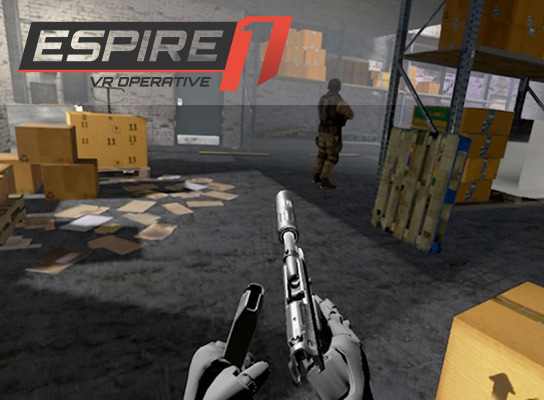
I have spent half of 2016 planning a VR Stealth game, “Espire 1: VR Operative”. Over December-Jan I created a basic prototype of the game and have now announced the project with a prototype video.
You can learn more about the project on my dedicated Espire 1 website. If you’re interested in being involved, do get in touch!
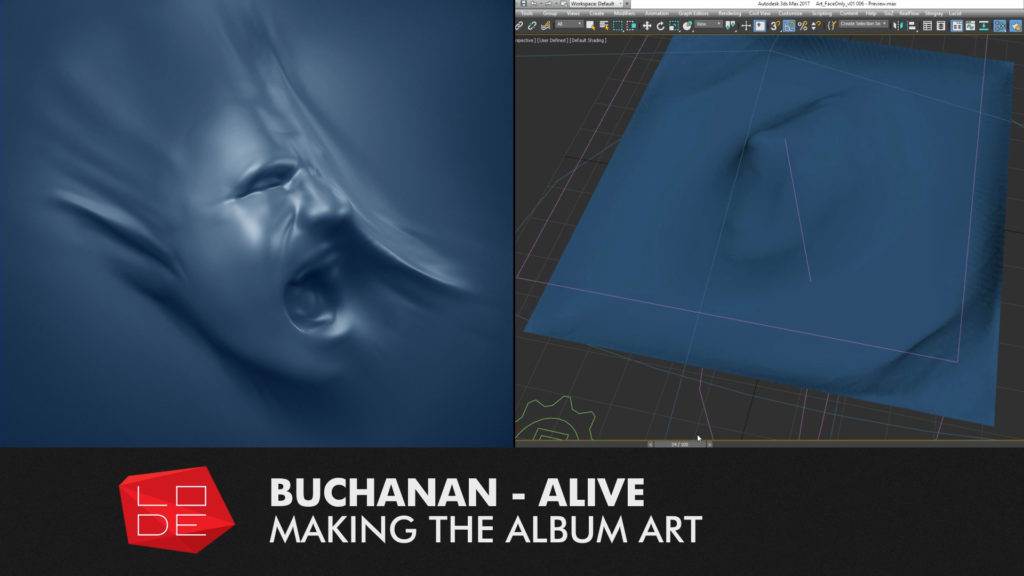
I’ve put together a short “making-of” video for Buchanan’s “Alive” album cover. Alive was released in the last week of October 2016 and I created the album cover which features lead singer Josh Simon’s head twisting under the pressure of a vacuum sheet! Josh wanted it to be cast blue – looking almost like an invert of the Pressure in an Empty Space album.
The video details the different steps that went into the process of creating the artwork.
Alive is available now on iTunes, Apple music and Spotify. You can learn more about the album here on the band’s official facebook page. This live album is linked to the recent “Pressure in an Empty Space” Studio album released by the band. I have more information on “PIAES” here on my LODE portfolio.
Alive Album Art – Process breakdown.
Here is an overview of my process when creating the album cover. More information is available in the video linked above.
Pre-Production
I went through a big phase of planning, brainstorming and pre-production with Josh Simons before we settled on the visual approach to “Pressure in an Empty Space” and how it would carry over to “Alive”.
Production began with a Photogrammetry session with Josh. This is where multiple photos are taken of a subject and the computer is able to reconstruct a digital model of the scene.
This was my first photogrammetry attempt, and so the results were not perfect. I learnt what not to do next time! The resulting model was quite distorted due to many factors including:
[list style=”list_1″] [li]Not enough photographs of the subject [/li] [li]Some photographs were blurry or out of focus
[/li] [li]Only 1 camera was used, so it was inevitable that the subject would move over the course of the shoot. I should have got Josh to lean the back of his head up against the plaster wall to keep it steady and remove clutter from the background[/li] [/list]
Sculpting
[image title=”Buchanan Alive Album Cover – Sculpting in Zbrush” width=”544″ height=”306″ align=”center” lightbox=”true” group=”BUCH” icon=”zoom”] http://thelode.com.au/wp-content/uploads/2016/11/04_Sculpting.jpg [/image]
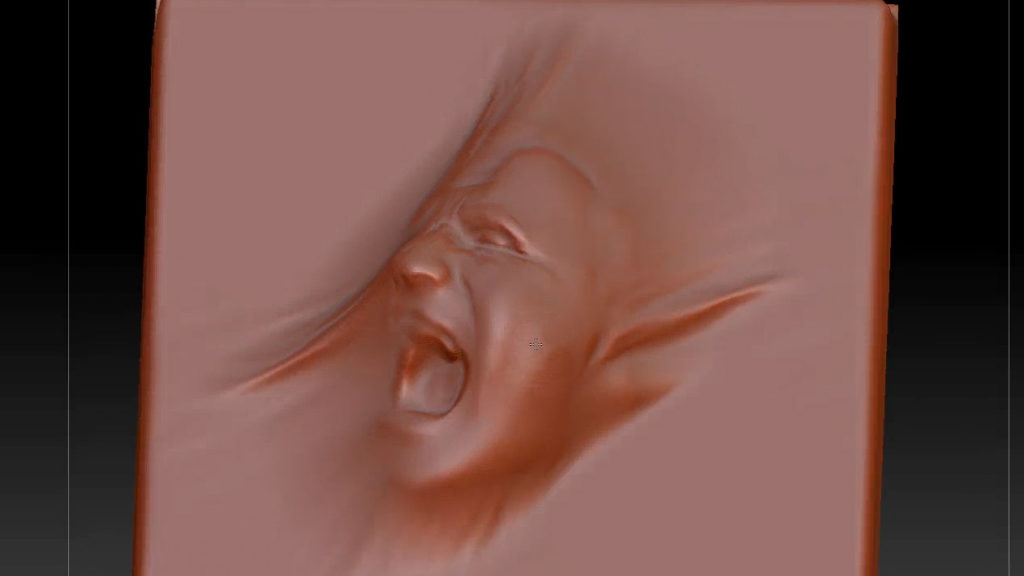
The digital version of Josh’s face was missing a lot of detail, but it was still great reference for the overall form and proportions, and so I built upon an auto-retopologised version of this model and used my original photos as reference while I sculpted a digital bust myself.
Scene setup
[image title=”Buchanan Alive Album Cover – Preparing mesh for simulation” width=”544″ height=”306″ align=”center” lightbox=”true” group=”BUCH” icon=”zoom”] http://thelode.com.au/wp-content/uploads/2016/11/05_SceneSetup.jpg [/image]
Once the face was ready I did some render tests and then prepared a capped version of the head optimised for dynamic simulation. I only needed the head – not the shoulders, etc. I wanted the topology of the model to be clean so as not to cause issues during dynamic simulations. I wanted to make the head look like it was being compressed under the pressure of a vacuum seal! I used the Lucid plugin for 3ds Max to achieve this. Lucid is a very versatile simulation system created by Ephere.
Simulation of cloth on Face
[image title=”Buchanan Alive Album Cover – Lucid Plugin for 3DS Max” width=”544″ height=”306″ align=”center” lightbox=”true” group=”BUCH” icon=”zoom”] http://thelode.com.au/wp-content/uploads/2016/11/06_Simulation.jpg [/image]
I then did some tests in how to set up my scene for Simulating. I sat the digital face on a flat surface & created a digital sheet that would be draped on top. I placed a large “Spherical Gravity” spacewarp below the face. It acted like a black hole – a vacuum that would suck all air in the area into its centre.
This, plus some gravity, wind and turbulence caused the sheet to try and push “through” the face as best it could – however the face would not let it. I found this was a quick way to get predictable results, and the Lucid plugin performed superbly.
Detail Sculpting
[image title=”Buchanan Alive Album Cover – Sculpting HiRes Mesh in Zbrush” width=”544″ height=”306″ align=”center” lightbox=”true” group=”BUCH” icon=”zoom”] http://thelode.com.au/wp-content/uploads/2016/11/07_Sculpting.jpg [/image]
After getting a satisfactory result (it took about 5 different simulation attempts to find the right settings), I exported one “Frame” of the cloth simulation to Zbrush. I also sent the underlying head/ground geometry to use in projection painting if needed. I then spent my time sculpting in extra details specifically where I wanted them, stretching and warping the cloth further, and getting the final desired look.
Exporting final high-res mesh
[image title=”Buchanan Alive Album Cover – Scene setup in 3ds Max and Vray” width=”544″ height=”306″ align=”center” lightbox=”true” group=”BUCH” icon=”zoom”] http://thelode.com.au/wp-content/uploads/2016/11/08_ExportingHiRes.jpg [/image]
The original Cloth had been planar UV-Mapped from the top, so it had correct UV co-ordinates – stretching where they naturally should. In the end I didn’t rely on UV co-ordinates in my shaders and the setup was very simple. I exported the Hi-Res mesh from Zbrush to 3ds Max using Decimation Master and Mesh Lab.
I setup my scene for rendering, first the “blue” Shader, then tweaked cameras and lights until I settled on a look that worked. I then spent time with Josh Simons to tweak all settings before the final render.
Final output
[image title=”Buchanan Alive Album Cover – Final Output” width=”544″ height=”306″ align=”center” lightbox=”true” group=”BUCH” icon=”zoom”] http://thelode.com.au/wp-content/uploads/2016/11/09-final-output.jpg [/image]
The scene was rendered in Vray 3.4 in 1 pass, with all required elements – DiffuseFilter, Reflection, Specular, GI, etc. All elements were then re-assembled in Photoshop to do the final Composite and grade. The Zdepth Mask was used to affect only the areas of the face that “Stick Out” of the main cloth. A final colour grade was applied and the image was flipped horizontally before being exported for print and digital use. The artwork was rendered at a resolution of around 5, 400 x 5,400 pixels to retain resolution when printing or scaling.
Conclusion
Every project I’ve worked on with Buchanan has been varied, challenging and extremely exciting, making use of many techniques and technologies, this cover was no exception. In the future I’ll create a video similar to this for the Pressure in an Empty Space cover. I hope this breakdown video and accompanying text post has been interesting and helpful.
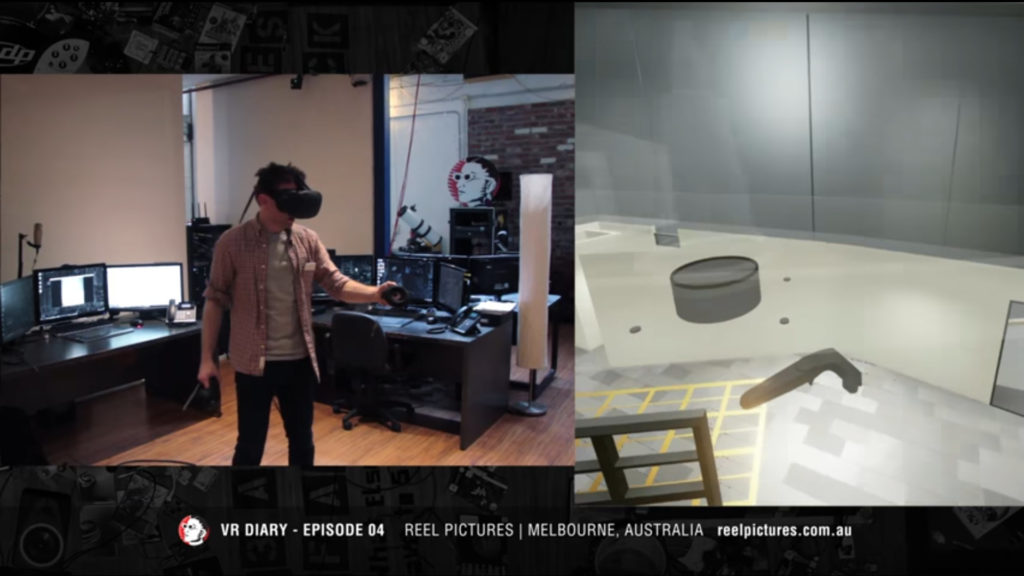
Our 4th VR Diary video is an overview of our “VR CAD Model Viewer”. This app allows you to view and interact with CAD data in Virtual Reality. The models sit on a virtual tabletop at user-specified scale. You can view these scale models from any angle and isolate specific areas. The user can explore key areas of the model in a 1:1 real-world scale.
We think it will be incredible useful for Architects, Industrial Designers and anyone who would want to use Virtual Reality for their Rapid Prototyping!
In this video, this VR app is in its early stages. In our future videos we will show some of the progress we’ve been making as well as some other examples where it could be useful in rapid prototyping for products and in industrial design applications.
The model featured in this video was Designed By Melbourne-based Architect Paul Evans. It is part of a submission to the Royal Society of Victoria by Paul Evans, Nigel Westbrook and Michael Wentworth-Bell.
At the moment, the process of preparing the model for VR is not automated – we are preparing the model in 3ds Max before sending it to Unreal.
We are in the process of automating as many of the processes as possible:
Generating Lightmap UVs
Creating adequate Collisions based on Floors, walls and ceiling
Assigning Unreal Shaders based on object name, layer name or existing material name
Placing key teleport points based on locations placed in Revit
Placement of Sun based on Geo Location set in Revit
Tagging of Doors, Glass and individual floors to allow users to isolate / toggle visibility
Depending on the complexity of the scene, Optimization of the resulting meshes is required. With some prep, The few test scenes we have worked with so far have maintained a stable 90fps in the headset on standard hardware.
There are a few solutions available for viewing CAD data in VR that are completely automated. Ours is not completely automated yet, but we are translating our experience in Arch-Vis into realtime VR, and can create projects that are a lot more specialised in their use – adding specific functionality per project.
This is a very popular and exciting use-case for VR tech and one I can see many CG studios being a part of!
I just finished the cover art for Buchanan’s upcoming ‘Alive’ album, a collaboration with lead singer Josh Simons. It’s his face that’s sculpted behind the sheet. Really fun project to work on once again!
In the next few weeks I plan to make a ‘making of’ video that details the process behind this album, which involved a few fun steps! I used some photogrammetry techniques to build a rough ‘sketch’ of the head, then sculpted a corrected version in Zbrush. I simulated the “Vacuum seal sheet” that seems to pushing in all around the face using the Ephere Lucid plugin for 3ds Max. I then added specific details to the simulated result – again in Zbrush. Finally it was rendered in 3ds Max using Vray and composited in Photoshop.
I’ve been working on a few different Virtual Reality “Demos” over the past few months at Reel Pictures. This post outlines the different VR demos we have been working on.
Inspired by the fantastic “Job Simulator” app, I’ve made a Virtual “cartridge” for each of the demos. People can put on the VR headset, literally pick up the cartridge they like, inspect it from any angle and then place it into our cartridge loader to begin the “Experience”.
All demos are currently in alpha so re-writable prototype carts are being used – haha. They will have proper label art closer to release.
(Above) This is what the front of the cartridges look like – very much inspired by the classic NES Cartridges. It was modelled in 3DS Max and textured in Substance Painter. This demo is a collection of “Landscape Tests” – large environments that can be explored in Virtual Reality.
(Above) This is the first VR demo I have began working on – a tool to view CAD models in a real-world scale in Virtual Reality – a VR Rapid Prototyping tool. This is one of the best use-cases for Virtual Reality at the current time (July 2016), in my opinion.
(Above) This demo is a tabletop CAD model viewer. It allows you to view large CAD models (such as apartment blocks) in Virtual Reality. They are viewed at scale – as if they are sitting on a table in-front of you. The user will eventually be able to “switch” between a scaled table-top model and a real-world scale model at will, change the time of day, view multiple versions of the same building on top of each other – for comparison, and much more. This is another fun demo that is the most developed.
(Above) This is the first VR demo I ever developed, a project that began in mid 2015. It is a Virtual Reality walkthrough of the “Museum of the Hoddle Grid” – a proposal by Paul Evans, Nigel Westbrook and myself to the Royal Society of Victoria. The Museum of the Hoddle Grid is pitched as as a museum dedicated to the history of the “Melbourne Grid” – the network of streets designed by Robert Hoddle. It will feature the world’s first Mixed Reality Exhibition space – where all the exhibits exist as digital holograms that interact with the physical environment around you. Since this was my first VR demo, its cartridge is gold! The main demo is an interactive walkthrough of the 1st-floor exhibition space. Another component of this VR demo is a scaled version of the entire building that you can view from any angle.
(Above) This is a Virtual Reality demo we are aiming to show museum directors, galleries and event management companies. The participant puts on their VR headset and appears on the 260m deck of the Akagi Aircraft carrier stationed in the middle of the ocean. Utilizing the VR motion controllers, they can use their hands to ‘pick apart’ a Mitsubishi Zero fighter plane that sits on the deck – picking up each of the aircraft panels one by one. They can also sit inside the cockpit of the plane!
[margin type=”30″]
Find out more
In the coming weeks I am going to be recording and sharing some videos of these VR Demos in action. If you are interested in trying out any of these demos, or chatting more about Virtual Reality, get in touch via my contact page or the Reel Pictures contact page.
My HTC Vive finally arrived, couldn’t be more excited! So far, I’ve only had 2 days to try out the HTC Vive with Alf and Mal but already i’m totally blown away.
If you get the opportunity to try it out you absolutely have to. I have previously tried heaps of different Google Cardboard, GearVR and Oculus DK2 experiences, and spent 2 months working on a DK2 demo. You can’t explain how cool it is to try Room-scale VR, where you can walk around freely, and see your hands, without trying it yourself. Can’t imagine how awesome VR will be in 3 years!
[image title=”Museum of the Hoddle Grid Presentation at the Royal Society of Victoria” width=”544″ height=”408″ align=”center” lightbox=”true” icon=”zoom”] http://thelode.com.au/wp-content/uploads/2016/10/2016-06-09_Virtual_Reality_Presentation_Reel_Pictures_FeaturedIMG.jpg [/image]
Tonight was the big night! I did a VR presentation to the Royal Society of Victoria with Paul Evans, Alf Kuhlmann and Ivy Tseung. The VR component was nearly 2 months in the making with 2 audience practice runs beforehand. It was really, really fun and we learnt a lot along the way!
We presented our idea of a “Museum of the Hoddle Grid” – envisioned by Paul Evans and Nigel Westbrook as a 3 story high multi-use building with a dedicated Mixed Reality exhibition space. This would be the 1 location dedicated to the history of Melbourne, Robert Hoddle and his Hoddle Grid.
Fingers crossed this proposal will eventually become a reality!
I recently presented my first VR Demo to an audience of Architects with the help of Melbourne based Architect Paul Evans, Reel Pictures Studio Director Alf Kuhlmann and my wife Ivy.
The demo is a Virtual Reality walkthrough for a new 3 story building proposal for the Royal Society of Victoria. This proposal is a collaboration with myself and Architects Paul Evans and Nigel Westbrook.
The 1st floor of this building houses the world’s first dedicated Mixed Reality Museum exhibition space. This is an exhibition dedicated the Hoddle Grid – the backbone of Melbourne.
It’s taken me 6 weeks to develop this very first VR experience. It allows the participant to walk around inside the proposed “Museum of the Hoddle Grid” exhibition area and get an idea of what the holographic virtual exhibits would be like.
We presented this demo to NH Architecture in Melbourne. Next week, we will give the same presentation to the Royal Society of Victoria. It has been a lot of fun (and a lot of late nights) putting it together. Thanks to my family and friends who gave it a test run and supplied some great feedback!
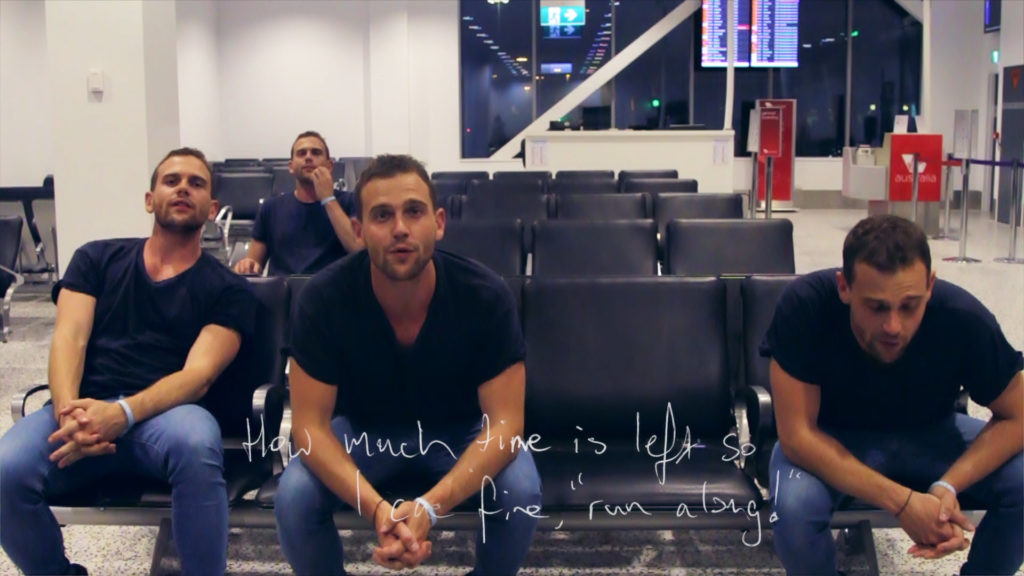
I recently put this video together for Buchanan. This was a very fun shoot at the Melbourne Airport that required a lot of Rotoscoping to composite everything all together!
In case you missed the premiere on @VamprApp, here is the brand new video for Pressure in an Empty Space! https://t.co/qlShuR84gZ
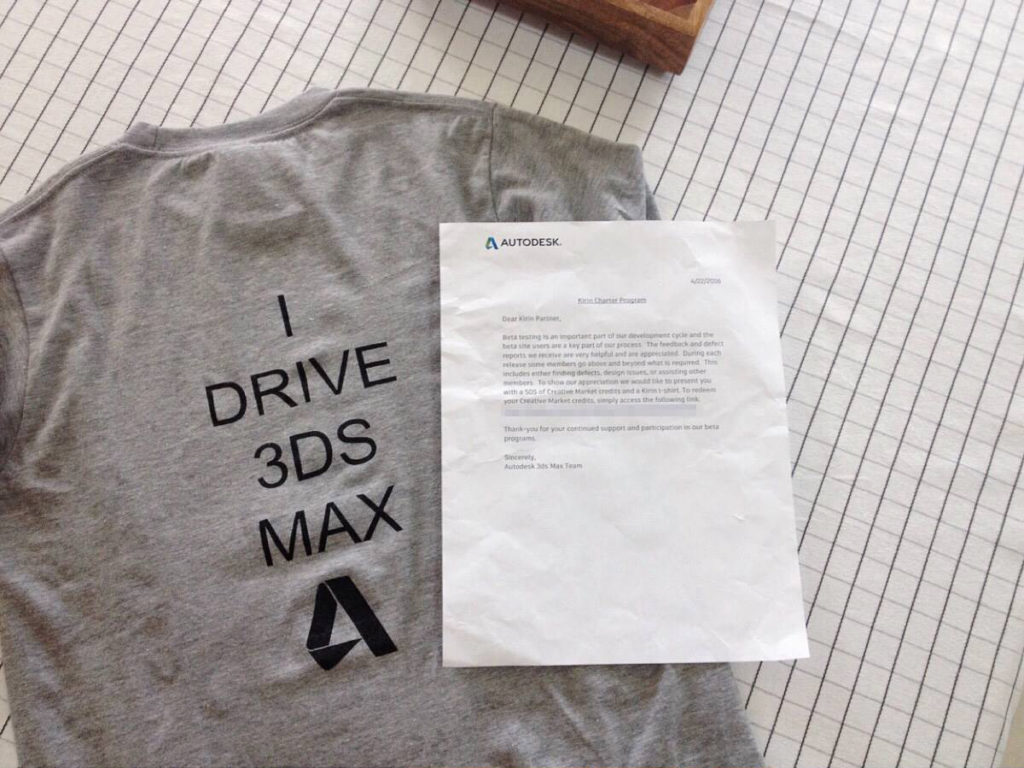
A cool tshirt from the 3ds Max development team : )
I love my job, making 3d “Stuff” all the time. I use 3ds Max for more hours every day than I care to admit.
I have been part of the 3ds max beta programme for 4 years. Last year I was very lucky to be a part of the 3ds Max “Charter” group and to get in touch with the developers and some of the best 3ds Max users around the globe. It has been great!